

Resources
Third-Party QA Is Really a Customer Experience Tool

Written by Lucas Sachs
In my last piece, I wrote about why the people building a digital product probably should not be the only people evaluating it. The central problem is familiarity: internal teams understand why a workflow exists, why something was built a certain way, which issues are already known, and what technical constraints shaped the product. That context is necessary to build software, but the customer does not have any of it.
That gap is where third-party QA becomes especially valuable, because the consequences of internal blind spots rarely stay confined to the software itself. They show up in the customer experience.
The customer is already grading the product
I learned this long before I started thinking about it in the context of software. I spent years working directly in customer experience, where performance was quite literally graded by the customer. We could have the right intentions, follow the right process, and believe we had handled an interaction correctly, but none of that necessarily mattered if the customer experienced it differently. Their survey, their NPS score, their review, or whether they came back became the final grade.
Digital products are not very different. The people responsible for the experience can have the right intentions, and the system can function exactly as intended, while the customer still grades it harshly. A payment can process successfully while leaving someone unsure whether it went through. A support workflow can route a customer to the correct department while still forcing them to leave the app, authenticate again, and explain the same problem from the beginning. Internally, everything may be working. Externally, the customer may see a broken experience.
In that sense, the customer is already performing third-party QA. The problem is that they are doing it after the product has reached them, and their evaluation shows up through complaints, abandonment, support volume, reviews, churn, or lost trust.
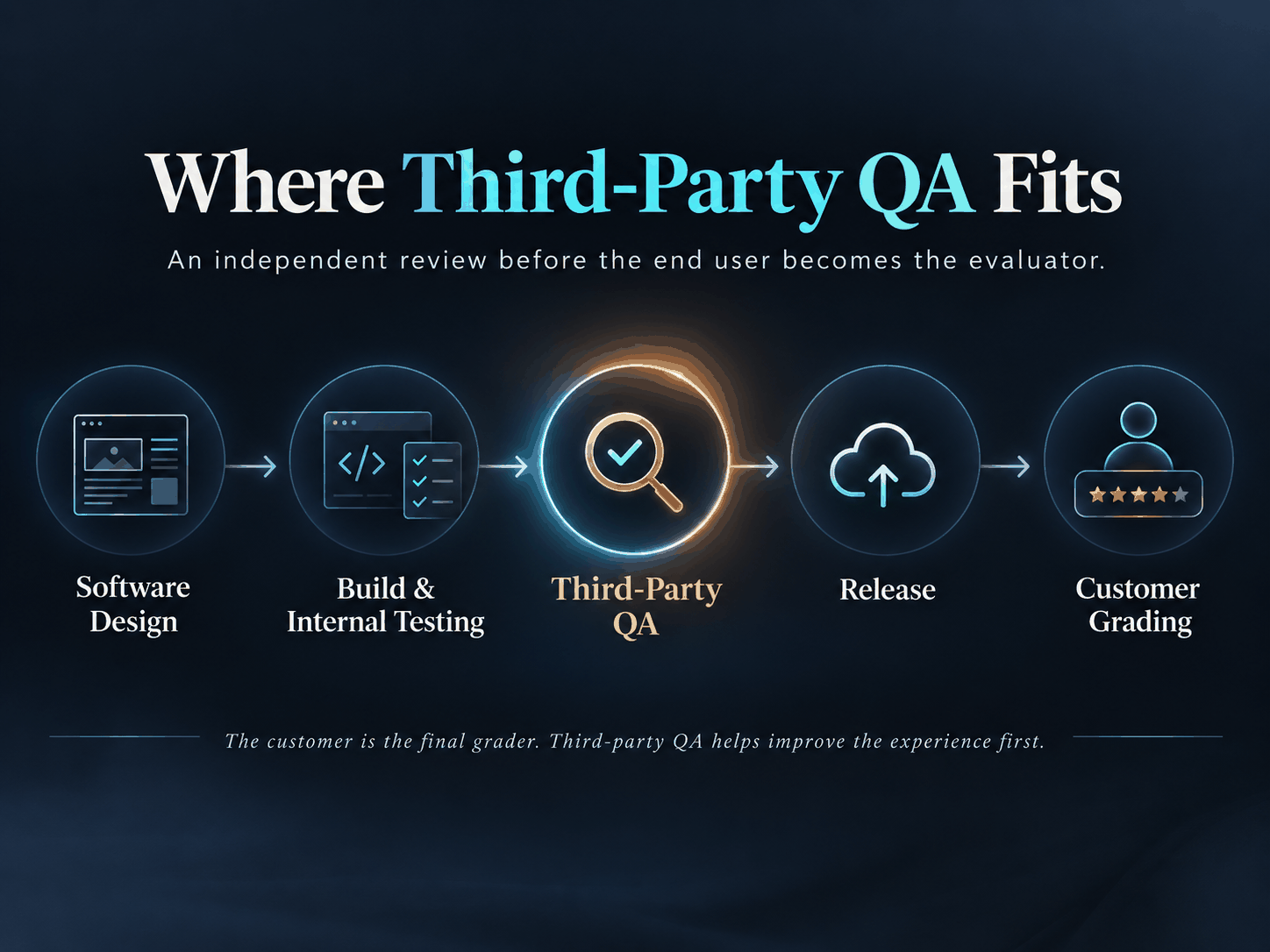
The opportunity is to introduce one more independent perspective before that final evaluation happens.
AI can scale good assumptions and bad ones

This becomes even more important as AI moves deeper into the software development process. AI can help teams write code, generate tests, document systems, identify bugs, prototype functionality, and ship changes significantly faster. It can also become extremely effective at confirming whether a product behaves according to the requirements it was given. Tepia is already applying AI inside existing products through AI integration services, where evaluation and controlled rollout are part of the implementation process rather than an afterthought.
The problem is that AI is still evaluating against an objective someone else defined. If the underlying assumption about the customer is wrong, AI can help build, test, and scale that assumption with remarkable efficiency. A workflow can pass every automated test and still frustrate the person using it.
As development becomes faster, that distinction matters more. AI can increase the speed of iteration, but speed does not automatically improve the experience. If the requirement is wrong, a faster build process simply gets the wrong experience into production sooner.
Third-party QA belongs before the customer becomes the evaluator

That is why I think third-party QA should extend beyond asking whether software functions according to its requirements. An external team can approach the product without all of the institutional knowledge surrounding it, which puts them much closer to the position of the eventual customer.
Instead of starting with how the system was intended to work, they can ask whether someone can actually accomplish what they came to do, whether the next step is obvious, where hesitation appears, and where the customer is forced into another channel to finish the process. Tepia’s QA and automated testing work combines automated testing with functional testing, user acceptance testing, and human judgment because not every meaningful failure is a broken line of code.
This is not an argument for replacing internal QA. Internal teams have deeper knowledge of the product, infrastructure, constraints, and roadmap than an outside team ever will. The value comes from adding a final independent layer with enough technical depth to understand the system and enough distance to question the experience before the customer has to.
The customer experiences one company

For companies whose primary business is not software, this matters even more. A relatively small development team, increasingly amplified by AI, can effectively control the digital front door of an organization with hundreds or thousands of employees. A confusing login, payment flow, account portal, or support experience can therefore shape how a customer perceives the entire company.
My background in customer experience is a large part of why I look at software this way now. Customers rarely separate the individual failures inside a business. They do not care which department owns the problem, which vendor powers the software, whether AI helped build it, or why one system does not communicate cleanly with another. They experience all of it as one company, and then they grade the company accordingly.
That is also why Tepia’s broader software development process treats testing as part of a larger sequence that includes discovery, design, development, testing, launch, and support. The experience has to be evaluated as a whole, not only as individual features passing individual tests.
A final independent check before the customer grades it
Independent QA creates a final layer of evaluation between the people who built the experience and the customer who will ultimately judge it. The internal team can explain why the product works the way it does. AI can verify whether it works as instructed. An independent third party can ask whether the customer is likely to experience it the way everyone intended.
As AI makes software faster and easier to build, that final layer of perspective may become more important, not less. The goal is not to slow development down. It is to make sure the increased speed still produces something the customer will grade well once it reaches them.
If you are responsible for a digital product and want another set of eyes on the experience your customers will ultimately grade, email me at lucas@tepia.co. I have spent enough time on both sides of that equation to know that the gap between something working as intended and actually working for the customer can be much larger than it appears internally. You can also talk to Tepia about independent QA, automated testing, or support for an existing digital product.